Key Points
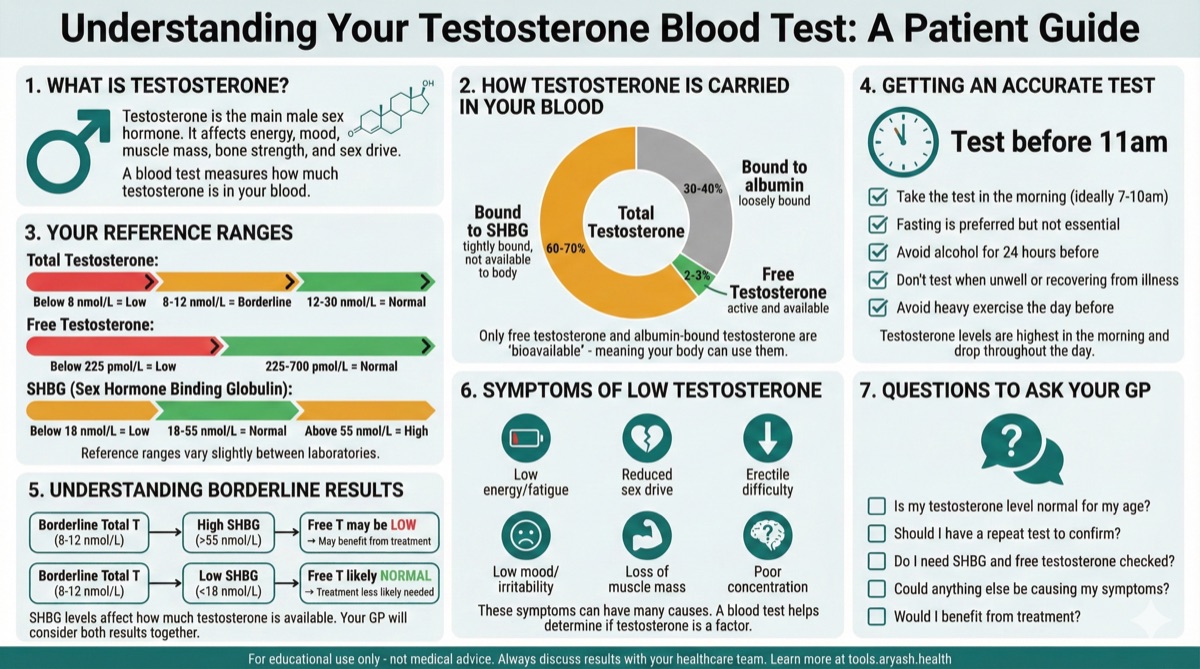
- Testosterone tests should be done in the morning (before 11am)
- Total testosterone is the main test — free testosterone helps interpret borderline results
- SHBG affects how much testosterone is available to your body
- One low result needs confirming with a repeat test
- Results must be interpreted alongside symptoms
The Testosterone Panel
A full testosterone assessment usually includes three tests:
How They Relate
Total Testosterone
All testosterone in your blood — the main measurement
Bound (to SHBG)
~60-70% — Not available for use
Free Testosterone
~2-3% — Active and available
Reference Ranges
These are typical UK laboratory reference ranges. Your lab may use slightly different values.
Total Testosterone
Measured in nmol/L (nanomoles per litre)
These are guide values used by GPs in the UK. Reference ranges vary between laboratories, and testosterone levels vary through the day (usually highest in the morning). Only your GP can interpret your result alongside your symptoms, the timing of the sample, and other hormones.
| Level | Range (nmol/L) | Range label |
|---|---|---|
| Low | Below 8 | Low range |
| Borderline | 8–12 | Borderline range |
| Normal | 12–31 | Typical range |
Free Testosterone
Measured in pmol/L (picomoles per litre)
| Level | Range (pmol/L) | Range label |
|---|---|---|
| Low | Below 180 | Low range |
| Normal | 180–740 | Typical range |
Free testosterone is often calculated rather than directly measured.
SHBG (Sex Hormone Binding Globulin)
Measured in nmol/L (nanomoles per litre)
| Level | Range (nmol/L) | What it means |
|---|---|---|
| Low | Below 18 | More free testosterone available |
| Normal | 18–54 | Typical range |
| High | Above 54 | Less free testosterone available |
Interpreting Your Results
Low Total Testosterone
- Results below 8 nmol/L are often described as low and usually prompt a repeat test and further assessment by your GP.
- Needs confirming with repeat test
- Further hormones checked (LH, FSH, prolactin)
- May warrant treatment if symptomatic
Normal Results
Results above 12 nmol/L are generally considered within the typical range. If you still have symptoms, speak to your GP — other causes may need to be explored.
Borderline (8–12 nmol/L)
- Grey zone — check free testosterone
- Consider SHBG levels
- Symptoms are important
- May need specialist input
Why SHBG Matters
SHBG is a protein that carries testosterone in your blood. It affects how much testosterone is actually available to your body.
High SHBG
- More testosterone is bound and unavailable
- Total testosterone may look normal but free testosterone is low
- Causes: ageing, liver disease, hyperthyroidism, some medications
Low SHBG
- More testosterone is free and available
- Total testosterone may look borderline but free testosterone is adequate
- Causes: obesity, type 2 diabetes, hypothyroidism
The Key Insight
SHBG helps your GP interpret a borderline total testosterone result. Depending on whether SHBG is high or low, the amount of free (usable) testosterone may differ — your GP factors this in when deciding whether any treatment should be considered.
Getting an Accurate Test
To ensure reliable results:
- Test in the morning — before 11am (testosterone peaks early)
- Fasting may be required — check with your GP
- Avoid alcohol — for 24-48 hours before
- Don't test when unwell — illness lowers testosterone temporarily
- Mention all medications — some affect results
Other Hormones Often Checked
If testosterone is low, your GP will usually check these to find the cause:
| Test | Purpose | What it shows |
|---|---|---|
| LH (Luteinising Hormone) | Brain signal to testicles | High = testicle problem, Low = brain/pituitary problem |
| FSH (Follicle Stimulating Hormone) | Sperm production signal | Helps identify the cause |
| Prolactin | Pituitary check | High levels can suppress testosterone |
| Oestradiol | Oestrogen level | Sometimes elevated in obesity |
What Next?
Based on your results:
If Normal
Your symptoms are unlikely due to low testosterone. Consider other causes like depression, poor sleep, or other medical conditions.
If Low or Borderline with Symptoms
- Repeat the test to confirm
- Check for reversible causes (obesity, medications, sleep apnoea)
- May be referred to endocrinology
- Testosterone replacement may be considered
Read our full guide on testosterone and treatment options.