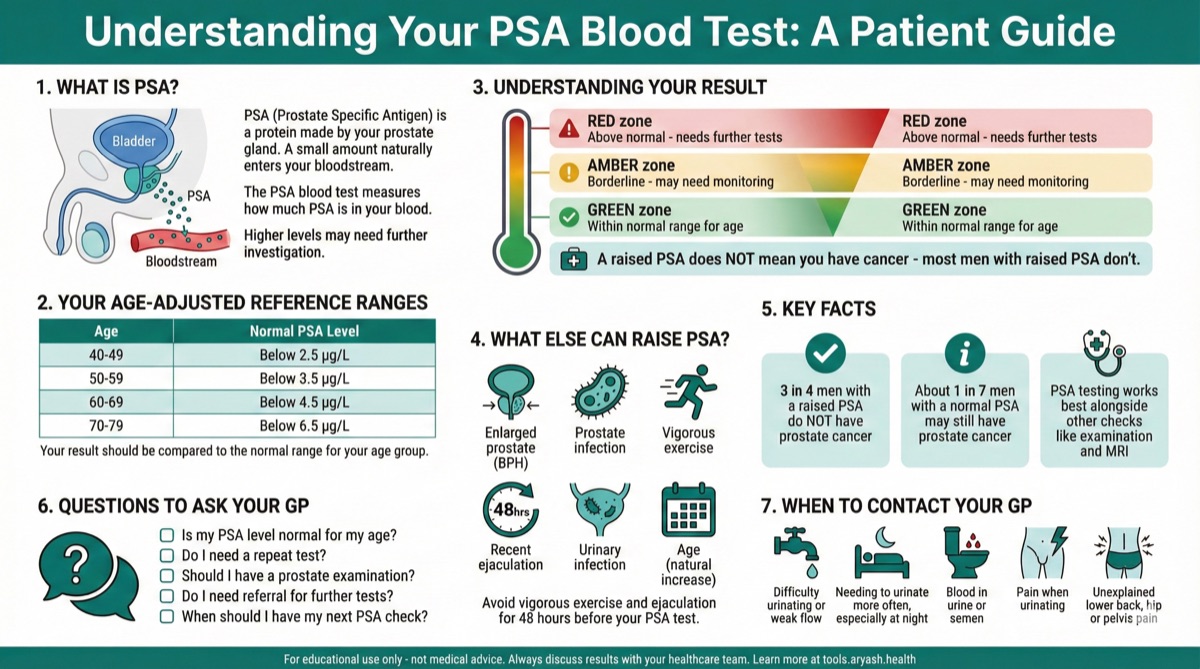
Key Points
- PSA is a protein made by the prostate gland
- A raised PSA does NOT always mean cancer — many causes are benign
- Normal PSA levels vary by age
- One raised result needs repeating before any action
- PSA testing has benefits and limitations — discuss with your GP
What is PSA?
Prostate-Specific Antigen (PSA) is a protein produced by both normal and cancerous cells in the prostate gland. It's measured with a simple blood test.
PSA naturally leaks into the bloodstream. The level can be raised by many things — not just cancer.
The test is used to:
- Help detect prostate problems, including cancer
- Monitor men already diagnosed with prostate cancer
- Track how well treatment is working
Understanding Your PSA Result
PSA is measured in micrograms per litre (µg/L) or sometimes shown as ng/mL (these are the same value).
PSA Level Guide (varies by age)
Normal
Below your age-specific threshold. Reassuring but not a guarantee.
Borderline
May need repeat testing or further investigation.
Elevated
Needs further assessment — doesn't mean cancer.
Age-related guide values GPs sometimes use
PSA naturally rises as men get older. These are general thresholds used in the UK:
These are guide values used by GPs to decide whether a result may need further checks. Interpretation depends on the lab, your symptoms, family history, ethnicity, and any medications affecting PSA (like finasteride). Only your GP can decide whether a result is concerning for you.
| Age | Guide value GPs often consider |
|---|---|
| 40–49 years | Below 2.5 |
| 50–59 years | Below 3.5 |
| 60–69 years | Below 4.5 |
| 70–79 years | Below 6.5 |
Important Note
These are guidelines, not absolute cut-offs. Your GP will consider your individual circumstances, family history, and any symptoms.
What Can Raise PSA?
Many things can increase your PSA level. Not all are serious.
Common Benign Causes
- Enlarged prostate (BPH)
- Prostatitis (infection)
- Urinary tract infection
- Recent ejaculation
- Vigorous exercise (cycling)
- Recent prostate examination
- Age — PSA rises naturally
More Serious Causes
- Prostate cancer
- Advanced prostate disease
Only about 1 in 4 men with raised PSA have prostate cancer
Before Your PSA Test
To get an accurate result, avoid these for 48 hours before the test:
- Ejaculation
- Vigorous exercise, especially cycling
- Having a digital rectal examination
Tell your GP if you have a urinary infection — wait until it's treated.
What Happens If PSA is Raised?
A raised PSA doesn't mean you have cancer. Your GP will usually:
- Repeat the test — One raised result needs confirming after 4-6 weeks
- Examine your prostate — Digital rectal examination (DRE)
- Review your symptoms — Urinary problems, pain, etc.
- Consider referral — To a urologist for further tests if needed
Further Tests May Include
- MRI scan — To look at the prostate in detail
- Prostate biopsy — Only if MRI shows suspicious areas
- Free PSA ratio — Can help distinguish cancer from benign causes
PSA Velocity and Density
Your doctor may also look at:
PSA Velocity
How fast your PSA changes over time is something your GP watches. A rising trend may matter more than a single reading. Your GP decides what rate of change is concerning in your situation.
PSA Density
Your PSA level divided by prostate size (measured on ultrasound or MRI). A larger prostate naturally produces more PSA.
Free PSA Ratio
PSA exists in two forms — "free" and "bound". Cancer tends to produce more bound PSA. A lower proportion of free PSA tends to be more concerning, while a higher proportion is more reassuring. Your GP interprets the exact figures alongside your other results.
Should I Get a PSA Test?
There's no national screening programme for prostate cancer in the UK. This is because:
- PSA can miss some cancers (false negatives)
- PSA can be raised without cancer (false positives)
- Some prostate cancers are slow-growing and may never cause problems
- Finding cancer can lead to treatment with side effects
However, men over 50 (or 45 with family history or Black African/Caribbean heritage) can request a PSA test from their GP after discussing the pros and cons.
When to See Your GP
Consider talking to your GP about PSA testing if you:
- Are over 50 years old
- Have a father or brother who had prostate cancer
- Are of Black African or Caribbean descent (higher risk)
- Have urinary symptoms (frequency, hesitancy, weak stream)
- Have unexplained back or bone pain